
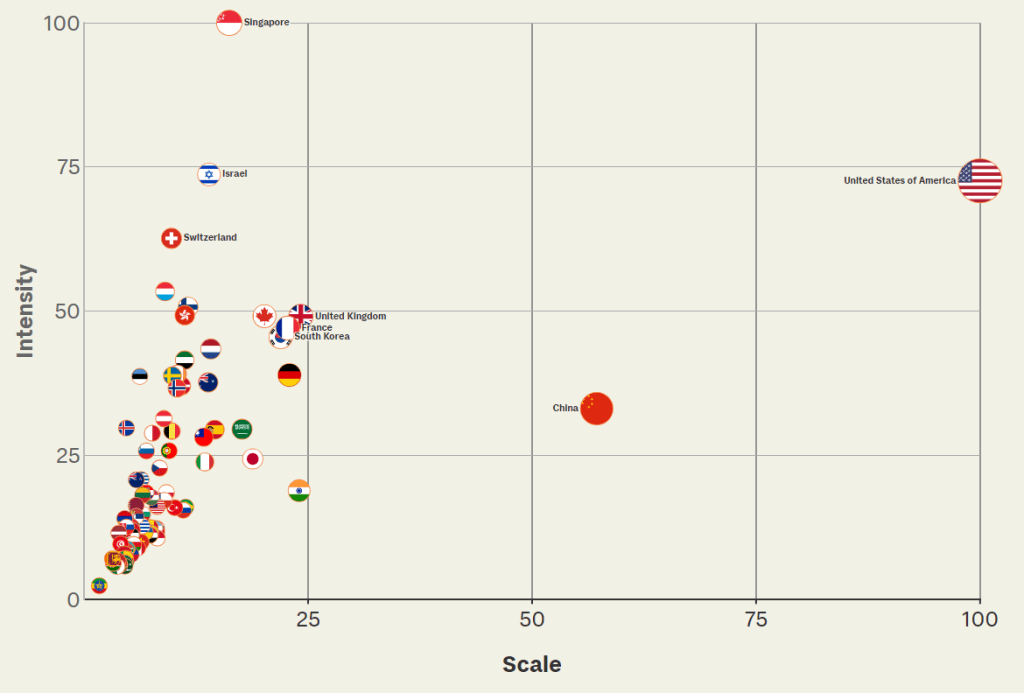
Interesting report by Tortoise on the maturity of AI landscape around the world, highlighting which countries are leading the race and explaining some of the reasons for their success:
https://lnkd.in/gTHv85P2
💡 KEY HIGHLIGHTS:
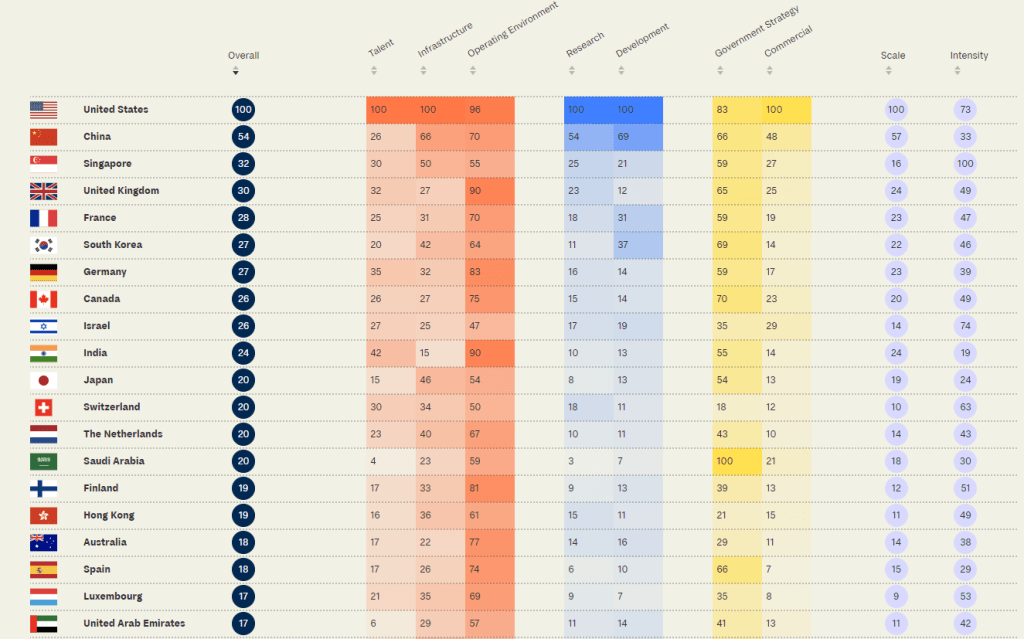
1️⃣ The United States remains the leader in the Global AI Index, widening its gap over China, which holds second place. Both nations are far ahead of others in the rankings.
2️⃣ Singapore retains third place, solidifying its position as Asia’s top AI hub after China. It excels in relative metrics, like AI scientists per capita, and has made significant progress in research and investment.
3️⃣ The UK narrowly keeps fourth place, but France is close behind, having jumped to fifth for the first time. France outperforms the UK in open-source LLM development, public spending, and computing.
4️⃣ South Korea stays in sixth, strong in industrial AI applications. Israel and Canada follow, with Israel excelling in private AI funding and Canada in government AI strategy.
5️⃣ India breaks into the top ten, driven by a diverse AI workforce, though much of its talent moves abroad. India’s AI success hasn’t yet translated into strong private investment or computing infrastructure.
6️⃣ Governments are increasing AI funding, with Saudi Arabia surpassing the US and China in public spending commitments.
7️⃣ Overall private AI investment is stable, but funding for generative AI has risen, with the US leading the market, dominated by a few tech giants.
Top20 countries:
🔎 PATH FORWARD:
Will be interesting to see how the dynamic changes in the next year. Here are some questions we recommend you to keep an eye on:
- Will the escalating US-China AI rivalry lead to tighter regulations and disrupt global AI collaboration?
- Can France maintain its rapid rise in AI rankings, challenging the UK’s position and altering the European AI landscape?
- Is the current surge in AI investment, especially in generative AI, sustainable, and what are the risks if funding diminishes?
- How will India’s talent migration impact its ability to convert a strong AI workforce into substantial domestic investment and infrastructure?
- Will the dominance of major US tech giants in generative AI limit competition and innovation, and how might this affect the global AI ecosystem?
 Frontiers of Technology